
U.S. Apartment Market Performance Solid in Early 2026
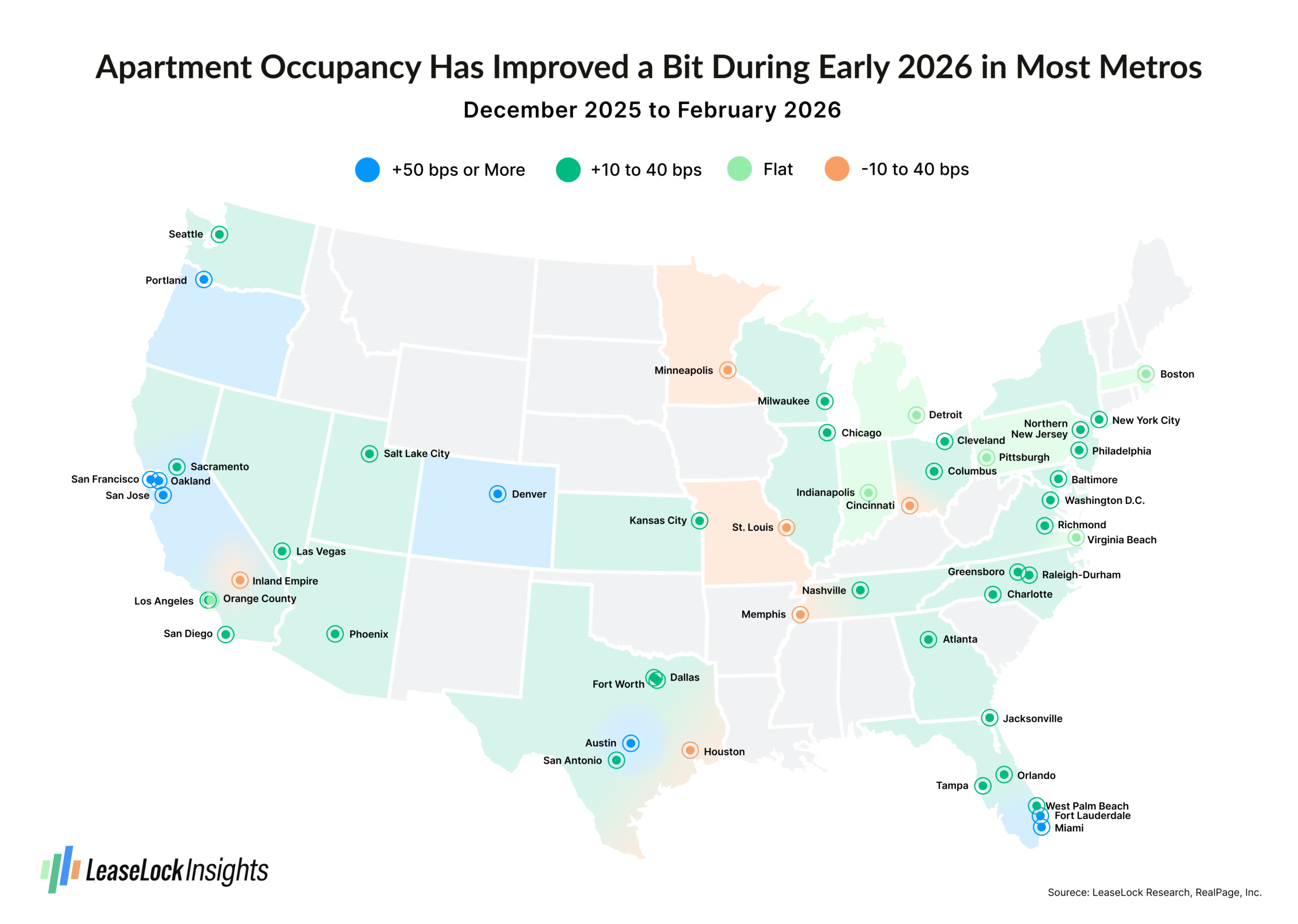
Market-rate apartment performances across the U.S. have registered a little momentum during the initial couple of months of 2026. While a lift in results aligns with the normal seasonality that is usually seen in core fundamentals during the first quarter, it’s a relief to witness both occupancy and rents moving upward when key economic indicators like job creation are less than ideal.
Improving National Stats
February’s occupancy rate for the nation’s stabilized communities – excluding the new product in initial lease-up – comes in at 94.8%, according to RealPage, Inc. data. That latest monthly reading is up 20 basis points (bps) from December’s level.
Same-store rents for move-in leases have trended up 0.5% so far this year, improving after monthly change had fallen into negative territory from July through December of 2025. A couple months of rent growth wasn’t quite enough to get annual change for move-in rents into positive territory as of February. However, renewal lease rent growth for the nation as a whole has remained healthy, landing at 3.5%.
A Couple of Regional Standouts
The Bay Area, inclusive of the San Francisco, San Jose and Oakland metros, is sustaining the strong momentum that was recorded last year, and the region now is experiencing the country’s hottest performance by a considerable margin.
Occupancy jumped by 100 bps from December to February, reaching 96.7%. Move-in rents surged 2.0% in just the initial two months of 2026, taking annual change to 5.3%. Rent growth for renewal leases also came in between 5% and 6%.
Results in Miami-South Florida, inclusive of the Miami, Fort Lauderdale and West Palm Beach metros, are improving, too.
At 95.5% as of February, occupancy for stabilized properties bumped up by 60 bps from the December 2025 level. Move-in rents inched ahead by 0.5% during the first two months of the year, pushing annual change from slightly negative territory to a just-barely positive reading. Renewal lease rents climbed by 3%.
Miami-South Florida routinely outperforms most of the rest of the country during the coldest weather months.
Perhaps Surprising Green Shoots
While performance improvements in the Bay Area and Miami-South Florida during early 2026 largely aligned with expectations, the return of some momentum in Austin perhaps wasn’t on your bingo card.
February occupancy in Austin’s stabilized projects of 92.8% still wasn’t great, but it was very encouraging to see an improvement of 70 bps since December. While occupancy gained some ground across all product segments, momentum proved most pronounced in the middle-tier Class B properties.
Move-in rents in the metro Austin same-store stabilized property set held essentially flat during 2026’s first couple of months, after rent cuts had occurred in 27 of the previous 30 months. Annual change for move-in rents still looks awful, with pricing down by 7% or so, but renewal rent change is positive at about 2%.
Austin’s apartment market still has a long way to go before it’s completely healed, and ongoing construction that tops 16,000 units points to challenges that are still significant. Nonetheless, emerging progress in the performance results is meaningful and welcome news.
What Comes Next
New apartment deliveries this year are scheduled to total around 300,000 units across the U.S., easing from 2025’s additions that topped 400,000 units. That pullback in completions sets up the market for stabilizing occupancy and an improvement in the move-in rent growth performance, especially as use of rent concessions begins to recede in the luxury product segment.
However, rental housing demand capacity looks fragile, reflecting uncertainty in the overall economic environment and general affordability challenges that have the potential to shift patterns in consumer behavior and spending priorities.
Market performance results seen so far in 2026 support the cautiously optimistic outlook expressed by many in the industry as the year began.
About LeaseLock
LeaseLock is the only true lease insurance provider for rental housing. Our AI powered underwriting program, LeaseLock ShieldTM, predicts risk and optimizes coverage for properties and portfolios. Owners and operators gain notable profit protection while accelerating leasing, minimizing burden, and removing reputation and legal risk. With over $14 billion in leases insured, LeaseLock is reshaping the way the rental housing industry manages financial risk, while delivering significant benefits to renters. As an accredited GRESB partner, LeaseLock is dedicated to improving housing accessibility by offering renters greater financial flexibility while protecting properties against the risk of bad debt.
 https://leaselock.com/wp-content/uploads/2026/03/FROM-THE-FIELD-25-scaled.png
1280
2560
Greg Willett
/wp-content/uploads/2024/04/LeaseLock-logo-black.svg
Greg Willett2026-03-16 12:49:082026-03-16 12:49:32U.S. Apartment Market Performance Solid in Early 2026
https://leaselock.com/wp-content/uploads/2026/03/FROM-THE-FIELD-25-scaled.png
1280
2560
Greg Willett
/wp-content/uploads/2024/04/LeaseLock-logo-black.svg
Greg Willett2026-03-16 12:49:082026-03-16 12:49:32U.S. Apartment Market Performance Solid in Early 2026 https://leaselock.com/wp-content/uploads/2026/01/FROM-THE-FIELD-24-scaled.png
1280
2560
Greg Willett
/wp-content/uploads/2024/04/LeaseLock-logo-black.svg
Greg Willett2026-01-14 02:13:102026-01-14 12:26:04Four Tiers of Apartment Rent Growth Across U.S. Metros
https://leaselock.com/wp-content/uploads/2026/01/FROM-THE-FIELD-24-scaled.png
1280
2560
Greg Willett
/wp-content/uploads/2024/04/LeaseLock-logo-black.svg
Greg Willett2026-01-14 02:13:102026-01-14 12:26:04Four Tiers of Apartment Rent Growth Across U.S. Metros https://leaselock.com/wp-content/uploads/2026/01/FROM-THE-FIELD-22-scaled.png
1280
2560
Greg Willett
/wp-content/uploads/2024/04/LeaseLock-logo-black.svg
Greg Willett2026-01-06 19:47:392026-01-06 19:47:41Apartment Demand Is Normalizing in 2026 as Supply Eases and Rent Growth Reemerges
https://leaselock.com/wp-content/uploads/2026/01/FROM-THE-FIELD-22-scaled.png
1280
2560
Greg Willett
/wp-content/uploads/2024/04/LeaseLock-logo-black.svg
Greg Willett2026-01-06 19:47:392026-01-06 19:47:41Apartment Demand Is Normalizing in 2026 as Supply Eases and Rent Growth Reemerges https://leaselock.com/wp-content/uploads/2025/12/FROM-THE-FIELD-21-scaled.png
1280
2560
Greg Willett
/wp-content/uploads/2024/04/LeaseLock-logo-black.svg
Greg Willett2025-12-01 14:39:012025-12-02 09:14:15Top Real Estate Markets to Watch: 2022-2026 Trends and Takeaways
https://leaselock.com/wp-content/uploads/2025/12/FROM-THE-FIELD-21-scaled.png
1280
2560
Greg Willett
/wp-content/uploads/2024/04/LeaseLock-logo-black.svg
Greg Willett2025-12-01 14:39:012025-12-02 09:14:15Top Real Estate Markets to Watch: 2022-2026 Trends and Takeaways https://leaselock.com/wp-content/uploads/2025/10/FROM-THE-FIELD-20-scaled.png
1280
2560
Greg Willett
/wp-content/uploads/2024/04/LeaseLock-logo-black.svg
Greg Willett2025-10-27 16:12:532025-11-04 09:16:18Apartment Lease-Up Challenges Persist as Deliveries Stay Elevated in 2025
https://leaselock.com/wp-content/uploads/2025/10/FROM-THE-FIELD-20-scaled.png
1280
2560
Greg Willett
/wp-content/uploads/2024/04/LeaseLock-logo-black.svg
Greg Willett2025-10-27 16:12:532025-11-04 09:16:18Apartment Lease-Up Challenges Persist as Deliveries Stay Elevated in 2025 https://leaselock.com/wp-content/uploads/2025/09/FROM-THE-FIELD-19-scaled.png
1280
2560
Greg Willett
/wp-content/uploads/2024/04/LeaseLock-logo-black.svg
Greg Willett2025-09-02 16:42:102025-09-23 13:21:27Apartment Demand Seasonality Is Fluid
https://leaselock.com/wp-content/uploads/2025/09/FROM-THE-FIELD-19-scaled.png
1280
2560
Greg Willett
/wp-content/uploads/2024/04/LeaseLock-logo-black.svg
Greg Willett2025-09-02 16:42:102025-09-23 13:21:27Apartment Demand Seasonality Is Fluid https://leaselock.com/wp-content/uploads/2025/08/FROM-THE-FIELD-18-scaled.png
1280
2560
Greg Willett
/wp-content/uploads/2024/04/LeaseLock-logo-black.svg
Greg Willett2025-08-29 10:07:332025-08-29 10:07:35Apartment Rent Growth by Building Type in 2025: High-Rises Lead
https://leaselock.com/wp-content/uploads/2025/08/FROM-THE-FIELD-18-scaled.png
1280
2560
Greg Willett
/wp-content/uploads/2024/04/LeaseLock-logo-black.svg
Greg Willett2025-08-29 10:07:332025-08-29 10:07:35Apartment Rent Growth by Building Type in 2025: High-Rises Lead https://leaselock.com/wp-content/uploads/2025/08/FROM-THE-FIELD-17-scaled.png
1280
2560
Greg Willett
/wp-content/uploads/2024/04/LeaseLock-logo-black.svg
Greg Willett2025-08-25 12:49:032025-08-25 12:49:33Apartment Rent Prospects for Late 2025
https://leaselock.com/wp-content/uploads/2025/08/FROM-THE-FIELD-17-scaled.png
1280
2560
Greg Willett
/wp-content/uploads/2024/04/LeaseLock-logo-black.svg
Greg Willett2025-08-25 12:49:032025-08-25 12:49:33Apartment Rent Prospects for Late 2025 https://leaselock.com/wp-content/uploads/2025/08/FROM-THE-FIELD-16-scaled.png
1280
2560
Greg Willett
/wp-content/uploads/2024/04/LeaseLock-logo-black.svg
Greg Willett2025-08-15 13:27:322025-08-15 13:29:15The Nation’s Hospitality-Fueled Economies Appear Vulnerable
https://leaselock.com/wp-content/uploads/2025/08/FROM-THE-FIELD-16-scaled.png
1280
2560
Greg Willett
/wp-content/uploads/2024/04/LeaseLock-logo-black.svg
Greg Willett2025-08-15 13:27:322025-08-15 13:29:15The Nation’s Hospitality-Fueled Economies Appear Vulnerable