Apartment Rent Outlook for Late 2025: Risks and Opportunities
Greg Willett, Chief Economist at LeaseLock, Inc.

Seasonal Rent Patterns in Late 2025
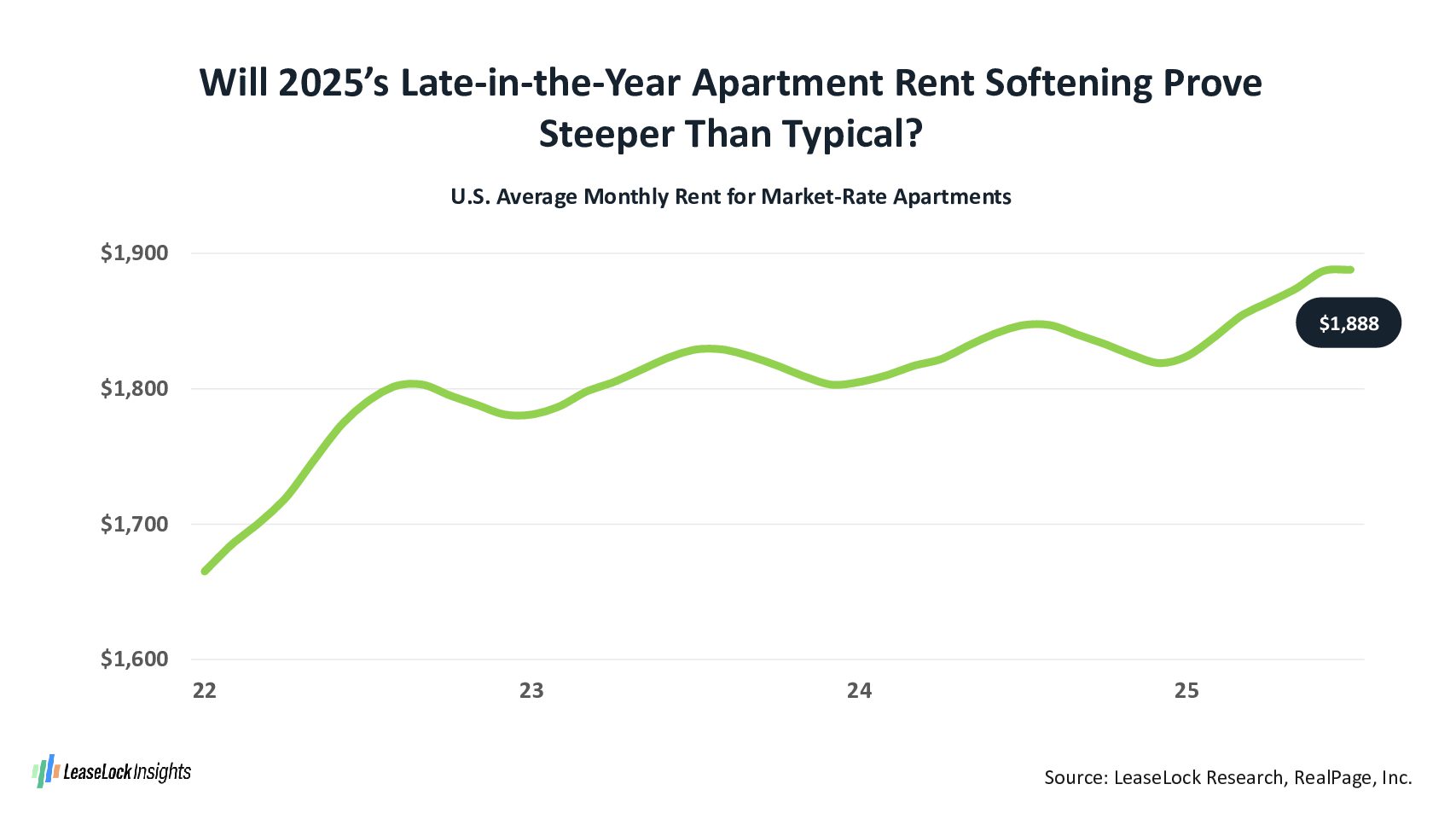
Rents for U.S. market-rate apartments normally peak in the July-August time frame and then backtrack a bit during the final months of the year. Influencing that pattern in pricing, leasing activity typically slows during the fall and winter months. In turn, most property owners and operators take a cautious approach when setting move-in rental rates as the year winds down, exhibiting caution in order to avoid a spike in product vacancy.
Heads-on-Beds Strategy vs. Rent Growth
The industry is now in its third consecutive year when a heads-on-beds strategy has reigned across the market as a whole. Owners and operators have prioritized occupancy over rent growth when new supply has reached historic highs. With deliveries still substantial, does the ongoing slowdown in job creation point to weakening demand that will further stall already modest pricing power?
Supply Dynamics and Their Impact on Pricing
There’s definitely some downside risk in the market performance outlook. But assuming mild job growth (versus meaningful losses) and a gradual increase in inflation (versus a surge), annual growth in move-in rents appears likely to hover near the 1% mark where it’s been stuck for two-plus years.
Renewal Lease Pricing and Resident Retention
One factor shaping that outlook is that completions in the latter months of 2025 will be off by at least a third from the volume seen a year ago, when new supply additions were at their heaviest. Also important to the annual change calculation for pricing power, the late 2024 decline in rents, about 1.5%, was especially steep because deliveries were so aggressive. That performance compares a more routine seasonal dip that tends to run around 0.5% or so. Thus, even rent losses that are a little more pronounced than normal over the course of the next few months won’t make much difference in the annual change results.
Also keep an eye on renewal lease pricing as we reach the end of 2025. Resident retention when existing leases expire tends to rise a bit during the colder months of the year, and the typical price bump for those opting to stay in place generally holds in the 3% to 5% range.
About LeaseLock
LeaseLock is the pioneer of lease insurance for rental housing, removing financial barriers for renters while ensuring reliable protection for housing providers. Trusted by property owners and operators nationwide, LeaseLock has secured over $17 billion in leases to advance a more efficient, accessible, and sustainable housing system.
 https://leaselock.com/wp-content/uploads/2026/08/Market-Insights-Featured-Images-4-scaled.png
1280
2560
Greg Willett
/wp-content/uploads/2024/04/LeaseLock-logo-black.svg
Greg Willett2026-08-25 17:38:192026-08-25 17:38:23Are We Overhyping the Impact of a Construction Slowdown?
https://leaselock.com/wp-content/uploads/2026/08/Market-Insights-Featured-Images-4-scaled.png
1280
2560
Greg Willett
/wp-content/uploads/2024/04/LeaseLock-logo-black.svg
Greg Willett2026-08-25 17:38:192026-08-25 17:38:23Are We Overhyping the Impact of a Construction Slowdown? https://leaselock.com/wp-content/uploads/2026/07/Market-Insights-Featured-Images-3-1-scaled.png
1280
2560
Greg Willett
/wp-content/uploads/2024/04/LeaseLock-logo-black.svg
Greg Willett2026-07-30 14:14:582026-07-31 11:42:31Resident Retention Fuels Renewal Lease Pricing Power
https://leaselock.com/wp-content/uploads/2026/07/Market-Insights-Featured-Images-3-1-scaled.png
1280
2560
Greg Willett
/wp-content/uploads/2024/04/LeaseLock-logo-black.svg
Greg Willett2026-07-30 14:14:582026-07-31 11:42:31Resident Retention Fuels Renewal Lease Pricing Power https://leaselock.com/wp-content/uploads/2026/06/Market-Insights-Featured-Images-1-scaled.png
1280
2560
Greg Willett
/wp-content/uploads/2024/04/LeaseLock-logo-black.svg
Greg Willett2026-06-03 11:29:002026-10-01 21:20:08Prime Leasing Season Apartment Demand Potential Appears Promising
https://leaselock.com/wp-content/uploads/2026/06/Market-Insights-Featured-Images-1-scaled.png
1280
2560
Greg Willett
/wp-content/uploads/2024/04/LeaseLock-logo-black.svg
Greg Willett2026-06-03 11:29:002026-10-01 21:20:08Prime Leasing Season Apartment Demand Potential Appears Promising https://leaselock.com/wp-content/uploads/2026/05/Market-Insights-Featured-Images-scaled.png
1280
2560
Greg Willett
/wp-content/uploads/2024/04/LeaseLock-logo-black.svg
Greg Willett2026-05-03 11:29:002026-10-01 20:20:40Class C Apartment Rents Backtrack Amid Shifting Demand
https://leaselock.com/wp-content/uploads/2026/05/Market-Insights-Featured-Images-scaled.png
1280
2560
Greg Willett
/wp-content/uploads/2024/04/LeaseLock-logo-black.svg
Greg Willett2026-05-03 11:29:002026-10-01 20:20:40Class C Apartment Rents Backtrack Amid Shifting Demand https://leaselock.com/wp-content/uploads/2026/04/FROM-THE-FIELD-26-scaled.png
1280
2560
Jonas Dominique
/wp-content/uploads/2024/04/LeaseLock-logo-black.svg
Jonas Dominique2026-04-06 11:30:272026-10-01 20:20:44U.S. Apartment Demand Starts 2026 on Solid Ground
https://leaselock.com/wp-content/uploads/2026/04/FROM-THE-FIELD-26-scaled.png
1280
2560
Jonas Dominique
/wp-content/uploads/2024/04/LeaseLock-logo-black.svg
Jonas Dominique2026-04-06 11:30:272026-10-01 20:20:44U.S. Apartment Demand Starts 2026 on Solid Ground https://leaselock.com/wp-content/uploads/2026/03/FROM-THE-FIELD-25-scaled.png
1280
2560
Greg Willett
/wp-content/uploads/2024/04/LeaseLock-logo-black.svg
Greg Willett2026-03-22 11:29:002026-10-01 20:20:49U.S. Apartment Market Performance Solid in Early 2026
https://leaselock.com/wp-content/uploads/2026/03/FROM-THE-FIELD-25-scaled.png
1280
2560
Greg Willett
/wp-content/uploads/2024/04/LeaseLock-logo-black.svg
Greg Willett2026-03-22 11:29:002026-10-01 20:20:49U.S. Apartment Market Performance Solid in Early 2026 https://leaselock.com/wp-content/uploads/2026/01/FROM-THE-FIELD-24-scaled.png
1280
2560
Greg Willett
/wp-content/uploads/2024/04/LeaseLock-logo-black.svg
Greg Willett2026-01-14 02:13:102026-10-01 20:20:54Four Tiers of Apartment Rent Growth Across U.S. Metros
https://leaselock.com/wp-content/uploads/2026/01/FROM-THE-FIELD-24-scaled.png
1280
2560
Greg Willett
/wp-content/uploads/2024/04/LeaseLock-logo-black.svg
Greg Willett2026-01-14 02:13:102026-10-01 20:20:54Four Tiers of Apartment Rent Growth Across U.S. Metros https://leaselock.com/wp-content/uploads/2026/01/FROM-THE-FIELD-22-scaled.png
1280
2560
Greg Willett
/wp-content/uploads/2024/04/LeaseLock-logo-black.svg
Greg Willett2026-01-06 19:47:392026-10-01 20:20:58Apartment Demand Is Normalizing in 2026 as Supply Eases and Rent Growth Reemerges
https://leaselock.com/wp-content/uploads/2026/01/FROM-THE-FIELD-22-scaled.png
1280
2560
Greg Willett
/wp-content/uploads/2024/04/LeaseLock-logo-black.svg
Greg Willett2026-01-06 19:47:392026-10-01 20:20:58Apartment Demand Is Normalizing in 2026 as Supply Eases and Rent Growth Reemerges https://leaselock.com/wp-content/uploads/2025/08/FROM-THE-FIELD-16-scaled.png
1280
2560
Greg Willett
/wp-content/uploads/2024/04/LeaseLock-logo-black.svg
Greg Willett2025-11-21 11:30:302026-10-01 21:23:21The Nation’s Hospitality-Fueled Economies Appear Vulnerable
https://leaselock.com/wp-content/uploads/2025/08/FROM-THE-FIELD-16-scaled.png
1280
2560
Greg Willett
/wp-content/uploads/2024/04/LeaseLock-logo-black.svg
Greg Willett2025-11-21 11:30:302026-10-01 21:23:21The Nation’s Hospitality-Fueled Economies Appear Vulnerable
Market analytics and research by LeaseLock Chief Economist Greg Willett