Class C Apartment Rents Backtrack Amid Shifting Demand
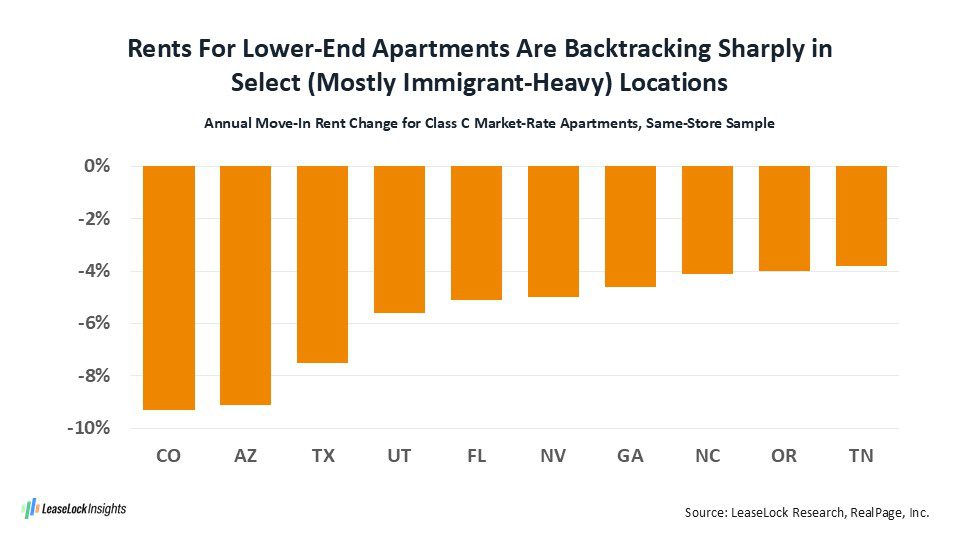
The nation’s most price-sensitive renters are receiving a notable break on housing costs. While this relief helps stretched household budgets, declining revenues point to growing financial pressure for some housing providers.
Current Trends in Workforce Housing Performance
Average apartment rents have largely stalled across much of the U.S. While a sizable block of completions has luxury property owners chasing residents, the most significant price cuts are occurring in the Class C property sector.
- Class C Move-in Rents: Down 2.7 percent year-over-year.
- Class A Performance: 0.9 percent rent growth in luxury units.
- Class B Performance: 0.7 percent decline in middle-market pricing.
Emerging Multifamily Demand Challenges
Rent moderation usually reflects new supply, but the current backtrack in Class C rents is a direct reflection of weakened demand. The pool of prospects for Class C housing has been reduced by slowed international immigration. These newcomers often rely on the market’s lowest-priced inventory.
Regional Performance Shifts:
- Colorado and Arizona: Class C rents down over 9 percent.
- Texas: Lower-end project rents down 7.5 percent.
- Other Impacted States: Utah, Florida, Nevada, Georgia, North Carolina, Oregon, and Tennessee.
Operational Strategies for Risk Mitigation
Revenue drops of this magnitude create immediate financial pressure for owners and operators. Compounding these difficulties, Class C communities often manage more bad debt due to missed payments compared to Class A or B counterparts.
The priority for housing providers in the Class C space is to retain as many existing residents as possible. Finding replacement renters is more difficult than in previous cycles, making retention the primary driver of revenue optimization.
About LeaseLock
LeaseLock is the pioneer of lease insurance for rental housing, removing financial barriers for renters while ensuring reliable protection for housing providers. Trusted by property owners and operators nationwide, LeaseLock has secured over $17 billion in leases to advance a more efficient, accessible, and sustainable housing system.
 https://leaselock.com/wp-content/uploads/2026/08/Market-Insights-Featured-Images-4-scaled.png
1280
2560
Greg Willett
/wp-content/uploads/2024/04/LeaseLock-logo-black.svg
Greg Willett2026-08-25 17:38:192026-08-25 17:38:23Are We Overhyping the Impact of a Construction Slowdown?
https://leaselock.com/wp-content/uploads/2026/08/Market-Insights-Featured-Images-4-scaled.png
1280
2560
Greg Willett
/wp-content/uploads/2024/04/LeaseLock-logo-black.svg
Greg Willett2026-08-25 17:38:192026-08-25 17:38:23Are We Overhyping the Impact of a Construction Slowdown? https://leaselock.com/wp-content/uploads/2026/07/Market-Insights-Featured-Images-3-1-scaled.png
1280
2560
Greg Willett
/wp-content/uploads/2024/04/LeaseLock-logo-black.svg
Greg Willett2026-07-30 14:14:582026-07-31 11:42:31Resident Retention Fuels Renewal Lease Pricing Power
https://leaselock.com/wp-content/uploads/2026/07/Market-Insights-Featured-Images-3-1-scaled.png
1280
2560
Greg Willett
/wp-content/uploads/2024/04/LeaseLock-logo-black.svg
Greg Willett2026-07-30 14:14:582026-07-31 11:42:31Resident Retention Fuels Renewal Lease Pricing Power https://leaselock.com/wp-content/uploads/2026/06/Market-Insights-Featured-Images-1-scaled.png
1280
2560
Greg Willett
/wp-content/uploads/2024/04/LeaseLock-logo-black.svg
Greg Willett2026-06-03 11:29:002026-10-01 21:20:08Prime Leasing Season Apartment Demand Potential Appears Promising
https://leaselock.com/wp-content/uploads/2026/06/Market-Insights-Featured-Images-1-scaled.png
1280
2560
Greg Willett
/wp-content/uploads/2024/04/LeaseLock-logo-black.svg
Greg Willett2026-06-03 11:29:002026-10-01 21:20:08Prime Leasing Season Apartment Demand Potential Appears Promising https://leaselock.com/wp-content/uploads/2026/05/Market-Insights-Featured-Images-scaled.png
1280
2560
Greg Willett
/wp-content/uploads/2024/04/LeaseLock-logo-black.svg
Greg Willett2026-05-03 11:29:002026-10-01 20:20:40Class C Apartment Rents Backtrack Amid Shifting Demand
https://leaselock.com/wp-content/uploads/2026/05/Market-Insights-Featured-Images-scaled.png
1280
2560
Greg Willett
/wp-content/uploads/2024/04/LeaseLock-logo-black.svg
Greg Willett2026-05-03 11:29:002026-10-01 20:20:40Class C Apartment Rents Backtrack Amid Shifting Demand https://leaselock.com/wp-content/uploads/2026/04/FROM-THE-FIELD-26-scaled.png
1280
2560
Jonas Dominique
/wp-content/uploads/2024/04/LeaseLock-logo-black.svg
Jonas Dominique2026-04-06 11:30:272026-10-01 20:20:44U.S. Apartment Demand Starts 2026 on Solid Ground
https://leaselock.com/wp-content/uploads/2026/04/FROM-THE-FIELD-26-scaled.png
1280
2560
Jonas Dominique
/wp-content/uploads/2024/04/LeaseLock-logo-black.svg
Jonas Dominique2026-04-06 11:30:272026-10-01 20:20:44U.S. Apartment Demand Starts 2026 on Solid Ground https://leaselock.com/wp-content/uploads/2026/03/FROM-THE-FIELD-25-scaled.png
1280
2560
Greg Willett
/wp-content/uploads/2024/04/LeaseLock-logo-black.svg
Greg Willett2026-03-22 11:29:002026-10-01 20:20:49U.S. Apartment Market Performance Solid in Early 2026
https://leaselock.com/wp-content/uploads/2026/03/FROM-THE-FIELD-25-scaled.png
1280
2560
Greg Willett
/wp-content/uploads/2024/04/LeaseLock-logo-black.svg
Greg Willett2026-03-22 11:29:002026-10-01 20:20:49U.S. Apartment Market Performance Solid in Early 2026 https://leaselock.com/wp-content/uploads/2026/01/FROM-THE-FIELD-24-scaled.png
1280
2560
Greg Willett
/wp-content/uploads/2024/04/LeaseLock-logo-black.svg
Greg Willett2026-01-14 02:13:102026-10-01 20:20:54Four Tiers of Apartment Rent Growth Across U.S. Metros
https://leaselock.com/wp-content/uploads/2026/01/FROM-THE-FIELD-24-scaled.png
1280
2560
Greg Willett
/wp-content/uploads/2024/04/LeaseLock-logo-black.svg
Greg Willett2026-01-14 02:13:102026-10-01 20:20:54Four Tiers of Apartment Rent Growth Across U.S. Metros https://leaselock.com/wp-content/uploads/2026/01/FROM-THE-FIELD-22-scaled.png
1280
2560
Greg Willett
/wp-content/uploads/2024/04/LeaseLock-logo-black.svg
Greg Willett2026-01-06 19:47:392026-10-01 20:20:58Apartment Demand Is Normalizing in 2026 as Supply Eases and Rent Growth Reemerges
https://leaselock.com/wp-content/uploads/2026/01/FROM-THE-FIELD-22-scaled.png
1280
2560
Greg Willett
/wp-content/uploads/2024/04/LeaseLock-logo-black.svg
Greg Willett2026-01-06 19:47:392026-10-01 20:20:58Apartment Demand Is Normalizing in 2026 as Supply Eases and Rent Growth Reemerges https://leaselock.com/wp-content/uploads/2025/08/FROM-THE-FIELD-16-scaled.png
1280
2560
Greg Willett
/wp-content/uploads/2024/04/LeaseLock-logo-black.svg
Greg Willett2025-11-21 11:30:302026-10-01 21:23:21The Nation’s Hospitality-Fueled Economies Appear Vulnerable
https://leaselock.com/wp-content/uploads/2025/08/FROM-THE-FIELD-16-scaled.png
1280
2560
Greg Willett
/wp-content/uploads/2024/04/LeaseLock-logo-black.svg
Greg Willett2025-11-21 11:30:302026-10-01 21:23:21The Nation’s Hospitality-Fueled Economies Appear Vulnerable
Market analytics and research by LeaseLock Chief Economist Greg Willett