Are We Overhyping the Impact of a Construction Slowdown?
Many of the apartment market assessments out there pointing toward the sector’s bright future start with the story that construction activity is slowing drastically from the levels seen recently.
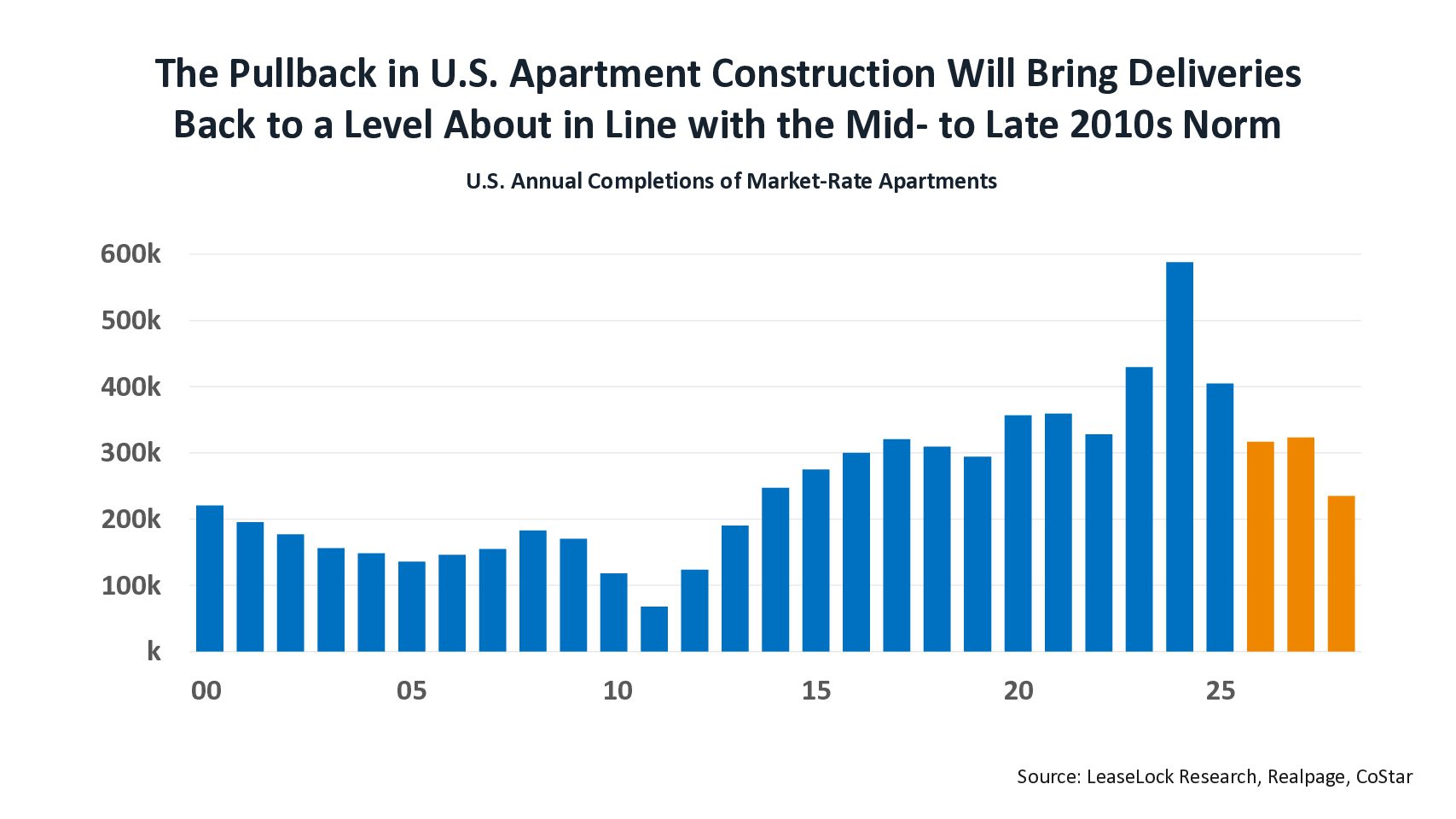
I’m optimistic about the industry’s near-term prospects, too. And I don’t dispute that deliveries over the next couple of years will come in well under what’s been seen of late. However, a pullback in new supply alone definitely does not automatically point to boom-time occupancy, rent growth and investment returns just ahead.
U.S. Apartment Construction Numbers: Comparing 2027–2028 Completions to Historical Norms
The nation’s completions of market-rate apartments in 2027-2028 should total around 280,000 units annually, averaging the new supply tallies predicted in Realpage and CoStar forecasts. (Keep in mind that all but the smallest properties that will be finished during 2027-2028 are already under construction now. Thus, it’s not surprising that various sources are expecting very similar totals of new supply over the next couple of years.) Those delivery totals are dramatically lower than the property additions that peaked at nearly 600,000 units in 2024 and averaged almost a half million units yearly during the 2023-2025 time frame.
It’s important to realize just how much those recent deliveries were elevated beyond the historical norm.
The mid- to late 2010s serve as the last period of sustained “normal” activity in the U.S. apartment sector. New supply in 2014-2019 averaged a hair under 300,000 market-rate units annually. Thus, while apartment completions over the next couple of years will really retreat from their recent peak volumes, they will barely trail that earlier typical delivery volume. Furthermore, if you throw BTR (Build-to-Rent) single-family homes – not a meaningful component of the housing market a decade ago – into the upcoming completion calculation, the near term’s total new supply of market-rate rentals should reach a bit above that 2014-2019 norm.
Evaluating Near-Term Multifamily Demand and Renter Household Creation
If 2027-2028 yearly market-rate housing completions prove to be similar to the 2014-2019 annual volume, will future demand also mirror the past norm of about 300,000 units per year?
There are reasons to be cautious when predicting product absorption capacity that lies just ahead.
Demographic Shifts and Young Adult Household Formation
Demographics – long a notable tailwind for apartment demand – don’t look quite as favorable over the next few years as they did during the past couple of economic cycles. Influencing the numbers, the U.S. birth rate faltered back in the Great Financial Crisis of the late 2000s and then never bounced back to earlier levels. The last babies born prior to the GFC are turning 18 this year, so the count of people reaching their young adult years will slow a bit during the immediate future, and it’s those young adults who fuel the creation of renter households.
Immigration Trends and Labor Force Dynamics
Near-term demand for housing in general and rentals specifically also will be dampened by the country’s current immigration policies. Census Bureau stats show that international arrivals peaked around 2.7 million people in 2024 and then slipped to roughly 1.3 million people in 2025. While we don’t have great real-time data on immigration levels, estimates for the 2026 total tend to max out at roughly 500,000 people, with some sources thinking the figure drops all the way to essentially zero.
Interesting new research from Harvard’s Joint Center for Housing Studies shows that it generally takes new immigrants a year or two to form countable additional households. In turn, the pullback in immigration that’s occurred already might not register its greatest impact on housing demand numbers until 2027-2028.
One more downside risk to near-term household formation totals registers in the not-great results for labor force participation, especially for young men, reported by the Bureau of Labor Statistics.
Homeownership Affordability Constraints
On the flipside, demand for rentals will be helped by the comparatively limited loss of renters to purchase, since affordability challenges are preventing some would-be buyers from achieving homeownership. Rental leasing activity yields more occupied units when households are not simply serving as replacements for those who left to buy homes.
The Bottom Line: What Supply and Demand Balance Means for Move-In Lease Pricing
Both supply and demand for rental housing now seem likely to back off from recent highs over the near term, ending up at levels that should be reasonably well matched in 2027-2028 for the country as a whole.
That supply-demand outlook points toward gradual firming in occupancy rates as well as at least a little acceleration in the lease-up pace for the newest completions and recent deliveries still building an initial base of residents.
Pricing power for move-in leases should improve relative to the results seen during the recent past, but the tide likely won’t be rising fast enough for rent growth to spike beyond the historical norm. Operational skill seems apt to play a big role in performance variation from one property to another, especially in the middle-market stock that accounts for roughly half of the nation’s total inventory.
With momentum likely to remain drastically bifurcated by asset class, overall results should be muted to some degree by struggles that probably will persist at lower-end communities, where household financial challenges and demand limited by immigration policy point toward further difficulties.
About LeaseLock
LeaseLock is the pioneer of lease insurance for rental housing, removing financial barriers for renters while ensuring reliable protection for housing providers. Trusted by property owners and operators nationwide, LeaseLock has secured over $17 billion in leases to advance a more efficient, accessible, and sustainable housing system.
 https://leaselock.com/wp-content/uploads/2026/08/Market-Insights-Featured-Images-4-scaled.png
1280
2560
Greg Willett
/wp-content/uploads/2024/04/LeaseLock-logo-black.svg
Greg Willett2026-08-25 17:38:192026-08-25 17:38:23Are We Overhyping the Impact of a Construction Slowdown?
https://leaselock.com/wp-content/uploads/2026/08/Market-Insights-Featured-Images-4-scaled.png
1280
2560
Greg Willett
/wp-content/uploads/2024/04/LeaseLock-logo-black.svg
Greg Willett2026-08-25 17:38:192026-08-25 17:38:23Are We Overhyping the Impact of a Construction Slowdown? https://leaselock.com/wp-content/uploads/2026/07/Market-Insights-Featured-Images-3-1-scaled.png
1280
2560
Greg Willett
/wp-content/uploads/2024/04/LeaseLock-logo-black.svg
Greg Willett2026-07-30 14:14:582026-07-31 11:42:31Resident Retention Fuels Renewal Lease Pricing Power
https://leaselock.com/wp-content/uploads/2026/07/Market-Insights-Featured-Images-3-1-scaled.png
1280
2560
Greg Willett
/wp-content/uploads/2024/04/LeaseLock-logo-black.svg
Greg Willett2026-07-30 14:14:582026-07-31 11:42:31Resident Retention Fuels Renewal Lease Pricing Power https://leaselock.com/wp-content/uploads/2026/06/Market-Insights-Featured-Images-1-scaled.png
1280
2560
Greg Willett
/wp-content/uploads/2024/04/LeaseLock-logo-black.svg
Greg Willett2026-06-03 11:29:002026-10-01 21:20:08Prime Leasing Season Apartment Demand Potential Appears Promising
https://leaselock.com/wp-content/uploads/2026/06/Market-Insights-Featured-Images-1-scaled.png
1280
2560
Greg Willett
/wp-content/uploads/2024/04/LeaseLock-logo-black.svg
Greg Willett2026-06-03 11:29:002026-10-01 21:20:08Prime Leasing Season Apartment Demand Potential Appears Promising https://leaselock.com/wp-content/uploads/2026/05/Market-Insights-Featured-Images-scaled.png
1280
2560
Greg Willett
/wp-content/uploads/2024/04/LeaseLock-logo-black.svg
Greg Willett2026-05-03 11:29:002026-10-01 20:20:40Class C Apartment Rents Backtrack Amid Shifting Demand
https://leaselock.com/wp-content/uploads/2026/05/Market-Insights-Featured-Images-scaled.png
1280
2560
Greg Willett
/wp-content/uploads/2024/04/LeaseLock-logo-black.svg
Greg Willett2026-05-03 11:29:002026-10-01 20:20:40Class C Apartment Rents Backtrack Amid Shifting Demand https://leaselock.com/wp-content/uploads/2026/04/FROM-THE-FIELD-26-scaled.png
1280
2560
Jonas Dominique
/wp-content/uploads/2024/04/LeaseLock-logo-black.svg
Jonas Dominique2026-04-06 11:30:272026-10-01 20:20:44U.S. Apartment Demand Starts 2026 on Solid Ground
https://leaselock.com/wp-content/uploads/2026/04/FROM-THE-FIELD-26-scaled.png
1280
2560
Jonas Dominique
/wp-content/uploads/2024/04/LeaseLock-logo-black.svg
Jonas Dominique2026-04-06 11:30:272026-10-01 20:20:44U.S. Apartment Demand Starts 2026 on Solid Ground https://leaselock.com/wp-content/uploads/2026/03/FROM-THE-FIELD-25-scaled.png
1280
2560
Greg Willett
/wp-content/uploads/2024/04/LeaseLock-logo-black.svg
Greg Willett2026-03-22 11:29:002026-10-01 20:20:49U.S. Apartment Market Performance Solid in Early 2026
https://leaselock.com/wp-content/uploads/2026/03/FROM-THE-FIELD-25-scaled.png
1280
2560
Greg Willett
/wp-content/uploads/2024/04/LeaseLock-logo-black.svg
Greg Willett2026-03-22 11:29:002026-10-01 20:20:49U.S. Apartment Market Performance Solid in Early 2026 https://leaselock.com/wp-content/uploads/2026/01/FROM-THE-FIELD-24-scaled.png
1280
2560
Greg Willett
/wp-content/uploads/2024/04/LeaseLock-logo-black.svg
Greg Willett2026-01-14 02:13:102026-10-01 20:20:54Four Tiers of Apartment Rent Growth Across U.S. Metros
https://leaselock.com/wp-content/uploads/2026/01/FROM-THE-FIELD-24-scaled.png
1280
2560
Greg Willett
/wp-content/uploads/2024/04/LeaseLock-logo-black.svg
Greg Willett2026-01-14 02:13:102026-10-01 20:20:54Four Tiers of Apartment Rent Growth Across U.S. Metros https://leaselock.com/wp-content/uploads/2026/01/FROM-THE-FIELD-22-scaled.png
1280
2560
Greg Willett
/wp-content/uploads/2024/04/LeaseLock-logo-black.svg
Greg Willett2026-01-06 19:47:392026-10-01 20:20:58Apartment Demand Is Normalizing in 2026 as Supply Eases and Rent Growth Reemerges
https://leaselock.com/wp-content/uploads/2026/01/FROM-THE-FIELD-22-scaled.png
1280
2560
Greg Willett
/wp-content/uploads/2024/04/LeaseLock-logo-black.svg
Greg Willett2026-01-06 19:47:392026-10-01 20:20:58Apartment Demand Is Normalizing in 2026 as Supply Eases and Rent Growth Reemerges https://leaselock.com/wp-content/uploads/2025/08/FROM-THE-FIELD-16-scaled.png
1280
2560
Greg Willett
/wp-content/uploads/2024/04/LeaseLock-logo-black.svg
Greg Willett2025-11-21 11:30:302026-10-01 21:23:21The Nation’s Hospitality-Fueled Economies Appear Vulnerable
https://leaselock.com/wp-content/uploads/2025/08/FROM-THE-FIELD-16-scaled.png
1280
2560
Greg Willett
/wp-content/uploads/2024/04/LeaseLock-logo-black.svg
Greg Willett2025-11-21 11:30:302026-10-01 21:23:21The Nation’s Hospitality-Fueled Economies Appear Vulnerable
Market analytics and research by LeaseLock Chief Economist Greg Willett