
Top Real Estate Markets to Watch: 2022–2026 Trends and Takeaways
1. Dallas-Fort Worth Is the Consistent National Leader
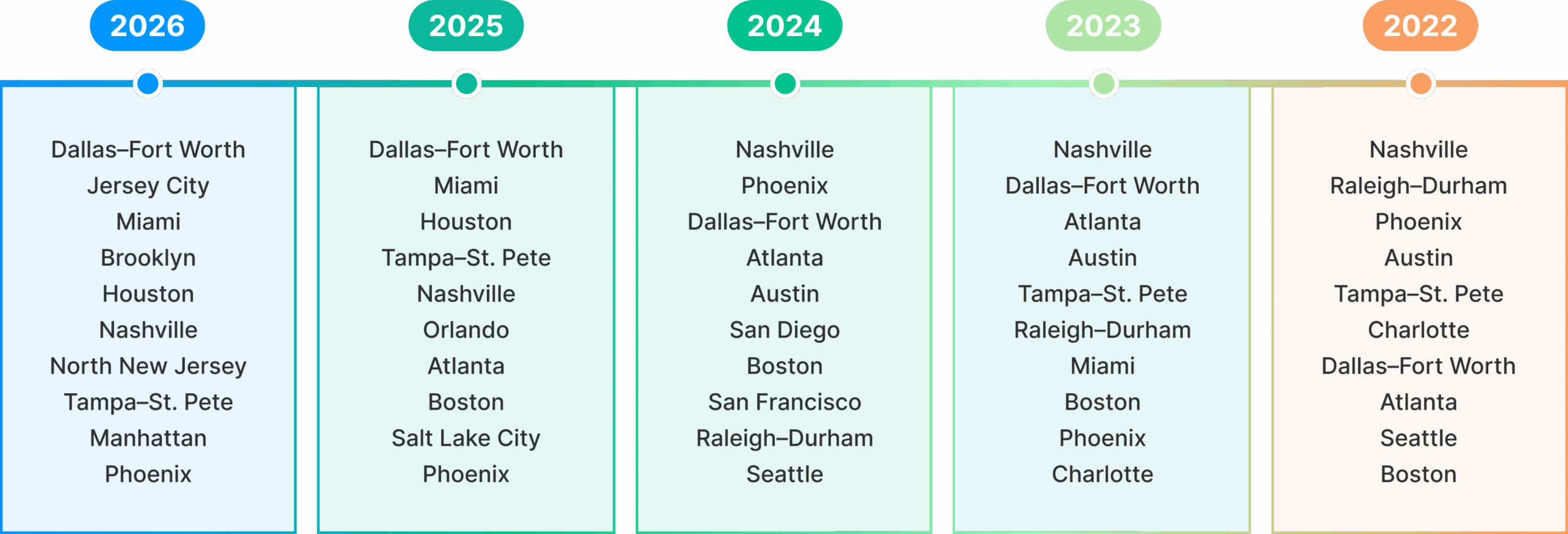
Dallas–Fort Worth appears in every year from 2022 through 2026, the only metro with that streak. Its combination of strong job growth, developer-friendly regulations, and diversified economic drivers continues to attract both capital and construction.
Why it matters: DFW remains the bellwether for tracking how national supply absorption and rent resilience perform under sustained delivery pressure.
2. Sun Belt Favorites Show Staying Power, but Cooling Trends Are Emerging
Markets like Nashville, Atlanta, Austin, Phoenix, Tampa, and Miami maintain a near-constant presence across years, underscoring their demographic and business migration appeal.
However, by 2026, smaller markets like Jersey City, Brooklyn, and North New Jersey reappear — suggesting capital rotation toward stability and affordability after years of Sun Belt saturation.
Why it matters: Investors may be recalibrating toward more balanced, higher-barrier coastal markets as rent growth normalizes in the South.
3. The Northeast Is Back on the Map
Boston, Manhattan, and North New Jersey make repeat appearances after being absent from early post-pandemic lists.
Why it matters: Renewed focus on transit-rich, mixed-use urban cores indicates confidence in employment and education hubs recovering from remote work slowdowns.
4. High-Rise Recovery Markets Gain Attention
Cities like New York, Boston, Chicago, and San Francisco (appearing intermittently) align with a resurgence in high-rise performance, mirroring Greg Willett’s recent commentary on A New Twist in Apartment Rent Growth by Building Height.
Why it matters: Demand for premium urban product may be stabilizing even as suburban garden developments face headwinds.
5. Investors Are Watching Job and Immigration Ties Closely
Several metros, notably Houston, Miami, and Phoenix, appear frequently due to robust job creation and population inflows. But as Greg highlighted in From the Field: New York, immigration and labor policy changes are emerging as key risk variables that could alter these growth paths.
Last Thoughts
Across five years of survey data, only a handful of metros consistently make the cut: Dallas-Fort Worth, Nashville, Phoenix, Atlanta, and Miami. These markets combine scalable multifamily pipelines with economic magnetism, but they’re also where oversupply, rent compression, and cost risk will hit hardest if demand wavers.
About LeaseLock
LeaseLock is the only true lease insurance provider for rental housing. Our AI powered underwriting program, LeaseLock ShieldTM, predicts risk and optimizes coverage for properties and portfolios. Owners and operators gain notable profit protection while accelerating leasing, minimizing burden, and removing reputation and legal risk. With over $14 billion in leases insured, LeaseLock is reshaping the way the rental housing industry manages financial risk, while delivering significant benefits to renters. As an accredited GRESB partner, LeaseLock is dedicated to improving housing accessibility by offering renters greater financial flexibility while protecting properties against the risk of bad debt.
 https://leaselock.com/wp-content/uploads/2026/03/FROM-THE-FIELD-25-scaled.png
1280
2560
Greg Willett
/wp-content/uploads/2024/04/LeaseLock-logo-black.svg
Greg Willett2026-03-16 12:49:082026-03-16 12:49:32U.S. Apartment Market Performance Solid in Early 2026
https://leaselock.com/wp-content/uploads/2026/03/FROM-THE-FIELD-25-scaled.png
1280
2560
Greg Willett
/wp-content/uploads/2024/04/LeaseLock-logo-black.svg
Greg Willett2026-03-16 12:49:082026-03-16 12:49:32U.S. Apartment Market Performance Solid in Early 2026 https://leaselock.com/wp-content/uploads/2026/01/FROM-THE-FIELD-24-scaled.png
1280
2560
Greg Willett
/wp-content/uploads/2024/04/LeaseLock-logo-black.svg
Greg Willett2026-01-14 02:13:102026-01-14 12:26:04Four Tiers of Apartment Rent Growth Across U.S. Metros
https://leaselock.com/wp-content/uploads/2026/01/FROM-THE-FIELD-24-scaled.png
1280
2560
Greg Willett
/wp-content/uploads/2024/04/LeaseLock-logo-black.svg
Greg Willett2026-01-14 02:13:102026-01-14 12:26:04Four Tiers of Apartment Rent Growth Across U.S. Metros https://leaselock.com/wp-content/uploads/2026/01/FROM-THE-FIELD-22-scaled.png
1280
2560
Greg Willett
/wp-content/uploads/2024/04/LeaseLock-logo-black.svg
Greg Willett2026-01-06 19:47:392026-01-06 19:47:41Apartment Demand Is Normalizing in 2026 as Supply Eases and Rent Growth Reemerges
https://leaselock.com/wp-content/uploads/2026/01/FROM-THE-FIELD-22-scaled.png
1280
2560
Greg Willett
/wp-content/uploads/2024/04/LeaseLock-logo-black.svg
Greg Willett2026-01-06 19:47:392026-01-06 19:47:41Apartment Demand Is Normalizing in 2026 as Supply Eases and Rent Growth Reemerges https://leaselock.com/wp-content/uploads/2025/12/FROM-THE-FIELD-21-scaled.png
1280
2560
Greg Willett
/wp-content/uploads/2024/04/LeaseLock-logo-black.svg
Greg Willett2025-12-01 14:39:012025-12-02 09:14:15Top Real Estate Markets to Watch: 2022-2026 Trends and Takeaways
https://leaselock.com/wp-content/uploads/2025/12/FROM-THE-FIELD-21-scaled.png
1280
2560
Greg Willett
/wp-content/uploads/2024/04/LeaseLock-logo-black.svg
Greg Willett2025-12-01 14:39:012025-12-02 09:14:15Top Real Estate Markets to Watch: 2022-2026 Trends and Takeaways https://leaselock.com/wp-content/uploads/2025/10/FROM-THE-FIELD-20-scaled.png
1280
2560
Greg Willett
/wp-content/uploads/2024/04/LeaseLock-logo-black.svg
Greg Willett2025-10-27 16:12:532025-11-04 09:16:18Apartment Lease-Up Challenges Persist as Deliveries Stay Elevated in 2025
https://leaselock.com/wp-content/uploads/2025/10/FROM-THE-FIELD-20-scaled.png
1280
2560
Greg Willett
/wp-content/uploads/2024/04/LeaseLock-logo-black.svg
Greg Willett2025-10-27 16:12:532025-11-04 09:16:18Apartment Lease-Up Challenges Persist as Deliveries Stay Elevated in 2025 https://leaselock.com/wp-content/uploads/2025/09/FROM-THE-FIELD-19-scaled.png
1280
2560
Greg Willett
/wp-content/uploads/2024/04/LeaseLock-logo-black.svg
Greg Willett2025-09-02 16:42:102025-09-23 13:21:27Apartment Demand Seasonality Is Fluid
https://leaselock.com/wp-content/uploads/2025/09/FROM-THE-FIELD-19-scaled.png
1280
2560
Greg Willett
/wp-content/uploads/2024/04/LeaseLock-logo-black.svg
Greg Willett2025-09-02 16:42:102025-09-23 13:21:27Apartment Demand Seasonality Is Fluid https://leaselock.com/wp-content/uploads/2025/08/FROM-THE-FIELD-18-scaled.png
1280
2560
Greg Willett
/wp-content/uploads/2024/04/LeaseLock-logo-black.svg
Greg Willett2025-08-29 10:07:332025-08-29 10:07:35Apartment Rent Growth by Building Type in 2025: High-Rises Lead
https://leaselock.com/wp-content/uploads/2025/08/FROM-THE-FIELD-18-scaled.png
1280
2560
Greg Willett
/wp-content/uploads/2024/04/LeaseLock-logo-black.svg
Greg Willett2025-08-29 10:07:332025-08-29 10:07:35Apartment Rent Growth by Building Type in 2025: High-Rises Lead https://leaselock.com/wp-content/uploads/2025/08/FROM-THE-FIELD-17-scaled.png
1280
2560
Greg Willett
/wp-content/uploads/2024/04/LeaseLock-logo-black.svg
Greg Willett2025-08-25 12:49:032025-08-25 12:49:33Apartment Rent Prospects for Late 2025
https://leaselock.com/wp-content/uploads/2025/08/FROM-THE-FIELD-17-scaled.png
1280
2560
Greg Willett
/wp-content/uploads/2024/04/LeaseLock-logo-black.svg
Greg Willett2025-08-25 12:49:032025-08-25 12:49:33Apartment Rent Prospects for Late 2025 https://leaselock.com/wp-content/uploads/2025/08/FROM-THE-FIELD-16-scaled.png
1280
2560
Greg Willett
/wp-content/uploads/2024/04/LeaseLock-logo-black.svg
Greg Willett2025-08-15 13:27:322025-08-15 13:29:15The Nation’s Hospitality-Fueled Economies Appear Vulnerable
https://leaselock.com/wp-content/uploads/2025/08/FROM-THE-FIELD-16-scaled.png
1280
2560
Greg Willett
/wp-content/uploads/2024/04/LeaseLock-logo-black.svg
Greg Willett2025-08-15 13:27:322025-08-15 13:29:15The Nation’s Hospitality-Fueled Economies Appear Vulnerable