Early 2026 Apartment Demand Proves Surprisingly Solid
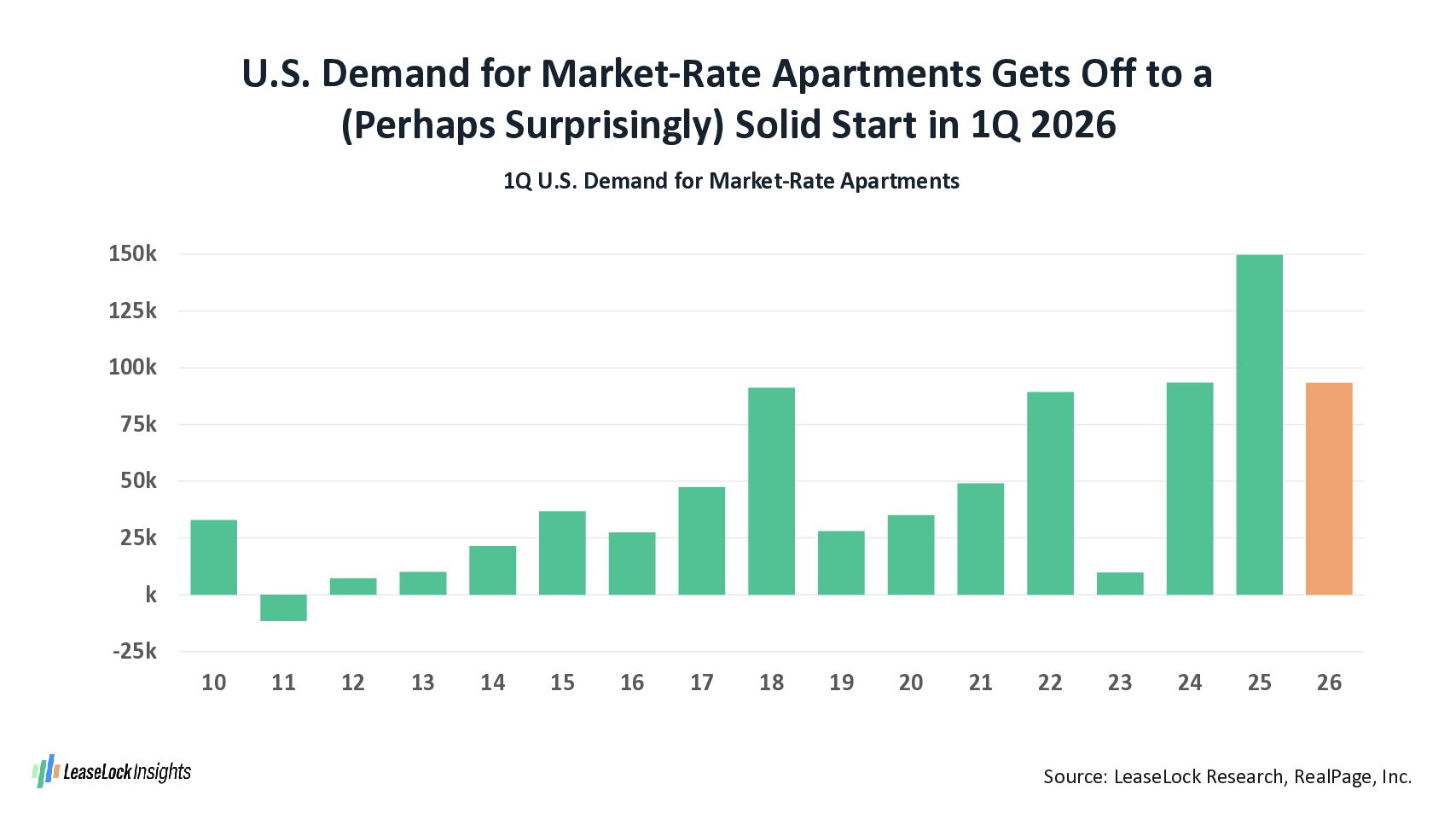
Apartment Demand Starts 2026 on Strong Footing
The U.S. apartment sector logged a healthy increase in occupied market-rate units during the first quarter of 2026, with demand holding up better than expected despite sluggish economic conditions.
U.S. apartment demand in 2026 got off to a solid start, as absorption during the January to March time frame reached roughly 95,000 units, according to RealPage, Inc. data. While that total fell short of 2025’s record-setting pace, it still came in well above historical norms.
At the same time, new supply slowed. Deliveries totaled about 75,000 units during the quarter, allowing demand to outpace completions by a meaningful margin.
Absorption Strength Across Major Markets
Apartment absorption momentum was broad-based to begin the year. Among the nation’s 50 largest metros, nearly every market registered positive demand, with the exception of Greensboro/Winston-Salem.
Top performers included:
- Dallas-Fort Worth with absorption of 8,500 units
- Phoenix with 7,200 units
- New York City with 6,100 units
Additional markets posting strong results in the 3,000 to 4,000 unit range included Northern New Jersey, Austin, Miami, and Denver.
These results reinforce that rental housing demand trends remain resilient across both Sun Belt and gateway markets, even as broader economic signals remain mixed.
What’s Driving Apartment Demand in 2026
Healthy demand in early 2026 was far from guaranteed.
Job growth has been inconsistent, inflation continues to pressure household budgets, and international migration is no longer contributing to demand at the same levels seen in recent years. These factors would typically point toward softer leasing activity.
However, two key dynamics have helped stabilize apartment demand in 2026:
1. Strong Resident Retention
Existing residents are staying put. RealPage data shows retention at 56% for leases expiring in early 2026. That means new leasing activity is more often translating into net occupancy gains rather than simply replacing move-outs.
2. Occupancy-Focused Pricing Strategies
Operators are continuing to prioritize occupancy over rent growth. While asking rents ticked up slightly during the quarter, year-over-year rent change remains modestly negative.
Pricing Strategy: Occupancy Over Rent Growth
Current multifamily occupancy trends in 2026 reflect a defensive posture from housing providers.
Rents have remained essentially flat since late 2022, and operators are leaning on concessions to maintain leasing velocity. Concession usage continued to increase early in the year, even as new supply, typically the biggest driver of incentives, has begun to slow.
This approach underscores a clear priority: protect occupancy first, and allow rent growth to follow when conditions improve.
What to Watch for the 2026 Leasing Season
The industry is now entering the seasonal peak leasing period that typically unfolds in the spring and summer months. While early-year demand has been encouraging, the most important stretch of the year is still ahead.
Several factors will shape performance:
- Renters are likely to remain highly price sensitive
- Rising costs, including transportation and everyday goods, may impact household formation
- Retention will remain a central focus for operators
- Expense management will continue to be closely monitored
In short, U.S. apartment demand in 2026 has started on solid footing, but sustained momentum will depend on how both renters and operators navigate a still uncertain economic environment.
About LeaseLock
LeaseLock is the pioneer of lease insurance for rental housing, removing financial barriers for renters while ensuring reliable protection for housing providers. Trusted by property owners and operators nationwide, LeaseLock has secured over $17 billion in leases to advance a more efficient, accessible, and sustainable housing system.
 https://leaselock.com/wp-content/uploads/2026/08/Market-Insights-Featured-Images-4-scaled.png
1280
2560
Greg Willett
/wp-content/uploads/2024/04/LeaseLock-logo-black.svg
Greg Willett2026-08-25 17:38:192026-08-25 17:38:23Are We Overhyping the Impact of a Construction Slowdown?
https://leaselock.com/wp-content/uploads/2026/08/Market-Insights-Featured-Images-4-scaled.png
1280
2560
Greg Willett
/wp-content/uploads/2024/04/LeaseLock-logo-black.svg
Greg Willett2026-08-25 17:38:192026-08-25 17:38:23Are We Overhyping the Impact of a Construction Slowdown? https://leaselock.com/wp-content/uploads/2026/07/Market-Insights-Featured-Images-3-1-scaled.png
1280
2560
Greg Willett
/wp-content/uploads/2024/04/LeaseLock-logo-black.svg
Greg Willett2026-07-30 14:14:582026-07-31 11:42:31Resident Retention Fuels Renewal Lease Pricing Power
https://leaselock.com/wp-content/uploads/2026/07/Market-Insights-Featured-Images-3-1-scaled.png
1280
2560
Greg Willett
/wp-content/uploads/2024/04/LeaseLock-logo-black.svg
Greg Willett2026-07-30 14:14:582026-07-31 11:42:31Resident Retention Fuels Renewal Lease Pricing Power https://leaselock.com/wp-content/uploads/2026/06/Market-Insights-Featured-Images-1-scaled.png
1280
2560
Greg Willett
/wp-content/uploads/2024/04/LeaseLock-logo-black.svg
Greg Willett2026-06-03 11:29:002026-10-01 21:20:08Prime Leasing Season Apartment Demand Potential Appears Promising
https://leaselock.com/wp-content/uploads/2026/06/Market-Insights-Featured-Images-1-scaled.png
1280
2560
Greg Willett
/wp-content/uploads/2024/04/LeaseLock-logo-black.svg
Greg Willett2026-06-03 11:29:002026-10-01 21:20:08Prime Leasing Season Apartment Demand Potential Appears Promising https://leaselock.com/wp-content/uploads/2026/05/Market-Insights-Featured-Images-scaled.png
1280
2560
Greg Willett
/wp-content/uploads/2024/04/LeaseLock-logo-black.svg
Greg Willett2026-05-03 11:29:002026-10-01 20:20:40Class C Apartment Rents Backtrack Amid Shifting Demand
https://leaselock.com/wp-content/uploads/2026/05/Market-Insights-Featured-Images-scaled.png
1280
2560
Greg Willett
/wp-content/uploads/2024/04/LeaseLock-logo-black.svg
Greg Willett2026-05-03 11:29:002026-10-01 20:20:40Class C Apartment Rents Backtrack Amid Shifting Demand https://leaselock.com/wp-content/uploads/2026/04/FROM-THE-FIELD-26-scaled.png
1280
2560
Jonas Dominique
/wp-content/uploads/2024/04/LeaseLock-logo-black.svg
Jonas Dominique2026-04-06 11:30:272026-10-01 20:20:44U.S. Apartment Demand Starts 2026 on Solid Ground
https://leaselock.com/wp-content/uploads/2026/04/FROM-THE-FIELD-26-scaled.png
1280
2560
Jonas Dominique
/wp-content/uploads/2024/04/LeaseLock-logo-black.svg
Jonas Dominique2026-04-06 11:30:272026-10-01 20:20:44U.S. Apartment Demand Starts 2026 on Solid Ground https://leaselock.com/wp-content/uploads/2026/03/FROM-THE-FIELD-25-scaled.png
1280
2560
Greg Willett
/wp-content/uploads/2024/04/LeaseLock-logo-black.svg
Greg Willett2026-03-22 11:29:002026-10-01 20:20:49U.S. Apartment Market Performance Solid in Early 2026
https://leaselock.com/wp-content/uploads/2026/03/FROM-THE-FIELD-25-scaled.png
1280
2560
Greg Willett
/wp-content/uploads/2024/04/LeaseLock-logo-black.svg
Greg Willett2026-03-22 11:29:002026-10-01 20:20:49U.S. Apartment Market Performance Solid in Early 2026 https://leaselock.com/wp-content/uploads/2026/01/FROM-THE-FIELD-24-scaled.png
1280
2560
Greg Willett
/wp-content/uploads/2024/04/LeaseLock-logo-black.svg
Greg Willett2026-01-14 02:13:102026-10-01 20:20:54Four Tiers of Apartment Rent Growth Across U.S. Metros
https://leaselock.com/wp-content/uploads/2026/01/FROM-THE-FIELD-24-scaled.png
1280
2560
Greg Willett
/wp-content/uploads/2024/04/LeaseLock-logo-black.svg
Greg Willett2026-01-14 02:13:102026-10-01 20:20:54Four Tiers of Apartment Rent Growth Across U.S. Metros https://leaselock.com/wp-content/uploads/2026/01/FROM-THE-FIELD-22-scaled.png
1280
2560
Greg Willett
/wp-content/uploads/2024/04/LeaseLock-logo-black.svg
Greg Willett2026-01-06 19:47:392026-10-01 20:20:58Apartment Demand Is Normalizing in 2026 as Supply Eases and Rent Growth Reemerges
https://leaselock.com/wp-content/uploads/2026/01/FROM-THE-FIELD-22-scaled.png
1280
2560
Greg Willett
/wp-content/uploads/2024/04/LeaseLock-logo-black.svg
Greg Willett2026-01-06 19:47:392026-10-01 20:20:58Apartment Demand Is Normalizing in 2026 as Supply Eases and Rent Growth Reemerges https://leaselock.com/wp-content/uploads/2025/08/FROM-THE-FIELD-16-scaled.png
1280
2560
Greg Willett
/wp-content/uploads/2024/04/LeaseLock-logo-black.svg
Greg Willett2025-11-21 11:30:302026-10-01 21:23:21The Nation’s Hospitality-Fueled Economies Appear Vulnerable
https://leaselock.com/wp-content/uploads/2025/08/FROM-THE-FIELD-16-scaled.png
1280
2560
Greg Willett
/wp-content/uploads/2024/04/LeaseLock-logo-black.svg
Greg Willett2025-11-21 11:30:302026-10-01 21:23:21The Nation’s Hospitality-Fueled Economies Appear Vulnerable
Market analytics and research by LeaseLock Chief Economist Greg Willett