Sun Belt Rent Growth Rebounds in 2025, Led by Tampa and Houston | May 21, 2025
Greg Willett, Chief Economist at LeaseLock, Inc.

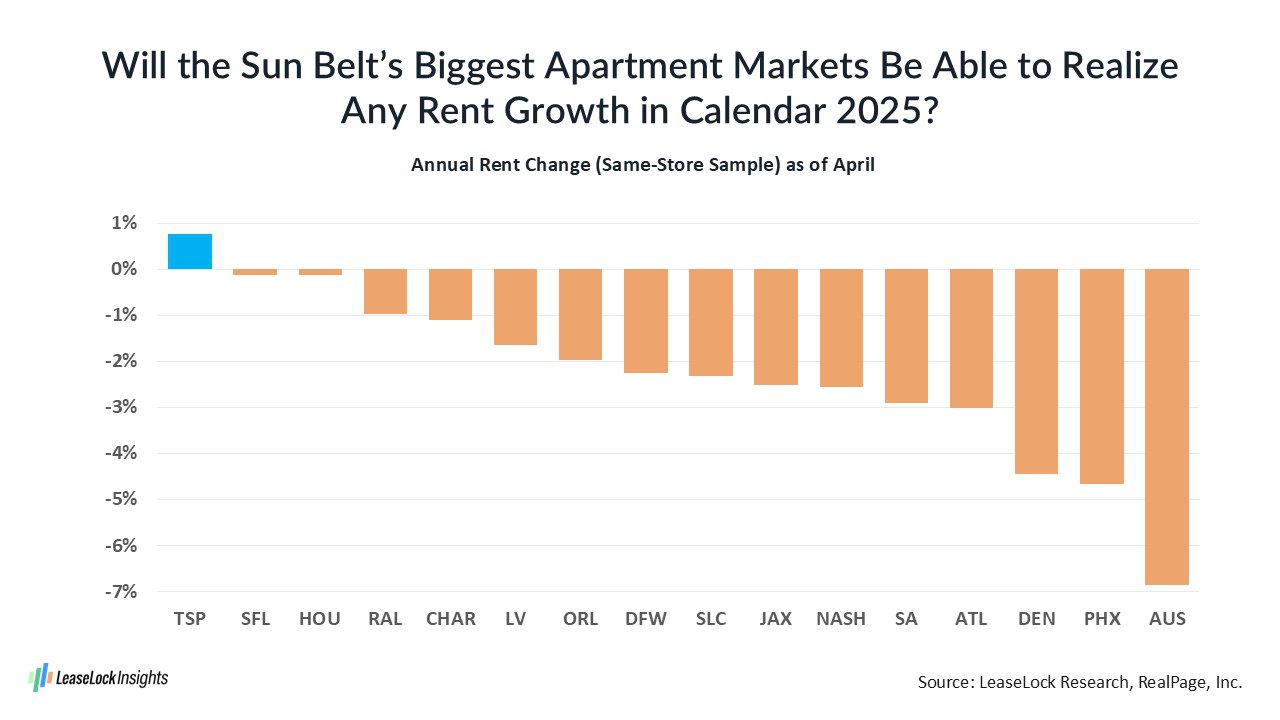
Today’s apartment rents in metro Tampa-St. Petersburg are up about 1% from year-ago pricing. Thus, the area is the first of the big construction centers across the Sun Belt and Mountain-Desert zone to move from rent cuts to rent growth. With demand proving strong at the same time that ongoing construction is down roughly 40% from its recent peak, Tampa-St. Pete appears to be a bellwether for broader Sun Belt rent growth in 2025, with accelerating pricing power expected through year-end.
Can other Sun Belt and Mountain-Desert markets experience similar momentum over the next few months?
That’s certainly the expectation for South Florida and Houston, where today’s rents are basically flat relative to year-ago pricing and where construction has moved from aggressive to more moderate levels. Houston, in particular, is well positioned in the 2025 Sun Belt rent growth narrative, thanks to rapid job gains and strong housing absorption.
Raleigh-Durham and Charlotte are another pair of markets that appear on track to post positive rent change outcomes by the end of this year, improving from the annual cuts of about 1% seen at present. Building activity remains quite substantial in these two areas, as ongoing construction will grow the existing inventory by more than 8% in Charlotte and by roughly 5% in Raleigh-Durham. But demand that’s coming in at stunning levels suggests that the markets will be able to handle all these additions without too much pain.
With annual rent cuts at less than 2% right now, Las Vegas and Orlando are candidates to realize at least a tiny bit of rent growth by the end of 2025. However, with the hospitality sector forming such big shares of their economies, spending shifts stemming from plunging consumer confidence and dropping international tourism suggest some vulnerability to those outlooks. Don’t be surprised if they don’t gain further pricing momentum just ahead.
Dallas-Fort Worth, Salt Lake City, Jacksonville, and Nashville are spots where apartment rents have backtracked a little more than 2% during the past year. Essentially breakeven metro average pricing seems like the most likely outcome when 2025 draws to a close, with a mix of neighborhood-level winners and losers seen in each area.
Today’s rent performance laggards are San Antonio, Atlanta, Denver, Phoenix, and Austin, with prices off 3% to 7% on a year-over-year basis. It’s a long shot to expect that any of these markets will manage to achieve overall rent bumps in calendar 2025, although the drawdowns in construction activity might be enough to yield emerging performance stabilization in some neighborhoods.
While not every metro will see upward movement, the broader trend toward Sun Belt rent growth in 2025 is gaining momentum—especially in metros where supply moderation and job recovery are taking hold.
About LeaseLock
LeaseLock is the pioneer of lease insurance for rental housing, removing financial barriers for renters while ensuring reliable protection for housing providers. Our AI-powered underwriting solution – LeaseLock Shield™ – harnesses the power of machine learning to determine the best coverage for each property and portfolio’s specific needs. Trusted by property owners and operators nationwide, LeaseLock has secured over $17 billion in leases to advance a more efficient, accessible, and sustainable housing system.
 https://leaselock.com/wp-content/uploads/2026/08/Market-Insights-Featured-Images-4-scaled.png
1280
2560
Greg Willett
/wp-content/uploads/2024/04/LeaseLock-logo-black.svg
Greg Willett2026-08-25 17:38:192026-08-25 17:38:23Are We Overhyping the Impact of a Construction Slowdown?
https://leaselock.com/wp-content/uploads/2026/08/Market-Insights-Featured-Images-4-scaled.png
1280
2560
Greg Willett
/wp-content/uploads/2024/04/LeaseLock-logo-black.svg
Greg Willett2026-08-25 17:38:192026-08-25 17:38:23Are We Overhyping the Impact of a Construction Slowdown? https://leaselock.com/wp-content/uploads/2026/07/Market-Insights-Featured-Images-3-1-scaled.png
1280
2560
Greg Willett
/wp-content/uploads/2024/04/LeaseLock-logo-black.svg
Greg Willett2026-07-30 14:14:582026-07-31 11:42:31Resident Retention Fuels Renewal Lease Pricing Power
https://leaselock.com/wp-content/uploads/2026/07/Market-Insights-Featured-Images-3-1-scaled.png
1280
2560
Greg Willett
/wp-content/uploads/2024/04/LeaseLock-logo-black.svg
Greg Willett2026-07-30 14:14:582026-07-31 11:42:31Resident Retention Fuels Renewal Lease Pricing Power https://leaselock.com/wp-content/uploads/2026/06/Market-Insights-Featured-Images-1-scaled.png
1280
2560
Greg Willett
/wp-content/uploads/2024/04/LeaseLock-logo-black.svg
Greg Willett2026-06-03 11:29:002026-10-01 21:20:08Prime Leasing Season Apartment Demand Potential Appears Promising
https://leaselock.com/wp-content/uploads/2026/06/Market-Insights-Featured-Images-1-scaled.png
1280
2560
Greg Willett
/wp-content/uploads/2024/04/LeaseLock-logo-black.svg
Greg Willett2026-06-03 11:29:002026-10-01 21:20:08Prime Leasing Season Apartment Demand Potential Appears Promising https://leaselock.com/wp-content/uploads/2026/05/Market-Insights-Featured-Images-scaled.png
1280
2560
Greg Willett
/wp-content/uploads/2024/04/LeaseLock-logo-black.svg
Greg Willett2026-05-03 11:29:002026-10-01 20:20:40Class C Apartment Rents Backtrack Amid Shifting Demand
https://leaselock.com/wp-content/uploads/2026/05/Market-Insights-Featured-Images-scaled.png
1280
2560
Greg Willett
/wp-content/uploads/2024/04/LeaseLock-logo-black.svg
Greg Willett2026-05-03 11:29:002026-10-01 20:20:40Class C Apartment Rents Backtrack Amid Shifting Demand https://leaselock.com/wp-content/uploads/2026/04/FROM-THE-FIELD-26-scaled.png
1280
2560
Jonas Dominique
/wp-content/uploads/2024/04/LeaseLock-logo-black.svg
Jonas Dominique2026-04-06 11:30:272026-10-01 20:20:44U.S. Apartment Demand Starts 2026 on Solid Ground
https://leaselock.com/wp-content/uploads/2026/04/FROM-THE-FIELD-26-scaled.png
1280
2560
Jonas Dominique
/wp-content/uploads/2024/04/LeaseLock-logo-black.svg
Jonas Dominique2026-04-06 11:30:272026-10-01 20:20:44U.S. Apartment Demand Starts 2026 on Solid Ground https://leaselock.com/wp-content/uploads/2026/03/FROM-THE-FIELD-25-scaled.png
1280
2560
Greg Willett
/wp-content/uploads/2024/04/LeaseLock-logo-black.svg
Greg Willett2026-03-22 11:29:002026-10-01 20:20:49U.S. Apartment Market Performance Solid in Early 2026
https://leaselock.com/wp-content/uploads/2026/03/FROM-THE-FIELD-25-scaled.png
1280
2560
Greg Willett
/wp-content/uploads/2024/04/LeaseLock-logo-black.svg
Greg Willett2026-03-22 11:29:002026-10-01 20:20:49U.S. Apartment Market Performance Solid in Early 2026 https://leaselock.com/wp-content/uploads/2026/01/FROM-THE-FIELD-24-scaled.png
1280
2560
Greg Willett
/wp-content/uploads/2024/04/LeaseLock-logo-black.svg
Greg Willett2026-01-14 02:13:102026-10-01 20:20:54Four Tiers of Apartment Rent Growth Across U.S. Metros
https://leaselock.com/wp-content/uploads/2026/01/FROM-THE-FIELD-24-scaled.png
1280
2560
Greg Willett
/wp-content/uploads/2024/04/LeaseLock-logo-black.svg
Greg Willett2026-01-14 02:13:102026-10-01 20:20:54Four Tiers of Apartment Rent Growth Across U.S. Metros https://leaselock.com/wp-content/uploads/2026/01/FROM-THE-FIELD-22-scaled.png
1280
2560
Greg Willett
/wp-content/uploads/2024/04/LeaseLock-logo-black.svg
Greg Willett2026-01-06 19:47:392026-10-01 20:20:58Apartment Demand Is Normalizing in 2026 as Supply Eases and Rent Growth Reemerges
https://leaselock.com/wp-content/uploads/2026/01/FROM-THE-FIELD-22-scaled.png
1280
2560
Greg Willett
/wp-content/uploads/2024/04/LeaseLock-logo-black.svg
Greg Willett2026-01-06 19:47:392026-10-01 20:20:58Apartment Demand Is Normalizing in 2026 as Supply Eases and Rent Growth Reemerges https://leaselock.com/wp-content/uploads/2025/08/FROM-THE-FIELD-16-scaled.png
1280
2560
Greg Willett
/wp-content/uploads/2024/04/LeaseLock-logo-black.svg
Greg Willett2025-11-21 11:30:302026-10-01 21:23:21The Nation’s Hospitality-Fueled Economies Appear Vulnerable
https://leaselock.com/wp-content/uploads/2025/08/FROM-THE-FIELD-16-scaled.png
1280
2560
Greg Willett
/wp-content/uploads/2024/04/LeaseLock-logo-black.svg
Greg Willett2025-11-21 11:30:302026-10-01 21:23:21The Nation’s Hospitality-Fueled Economies Appear Vulnerable
Market analytics and research by LeaseLock Chief Economist Greg Willett