
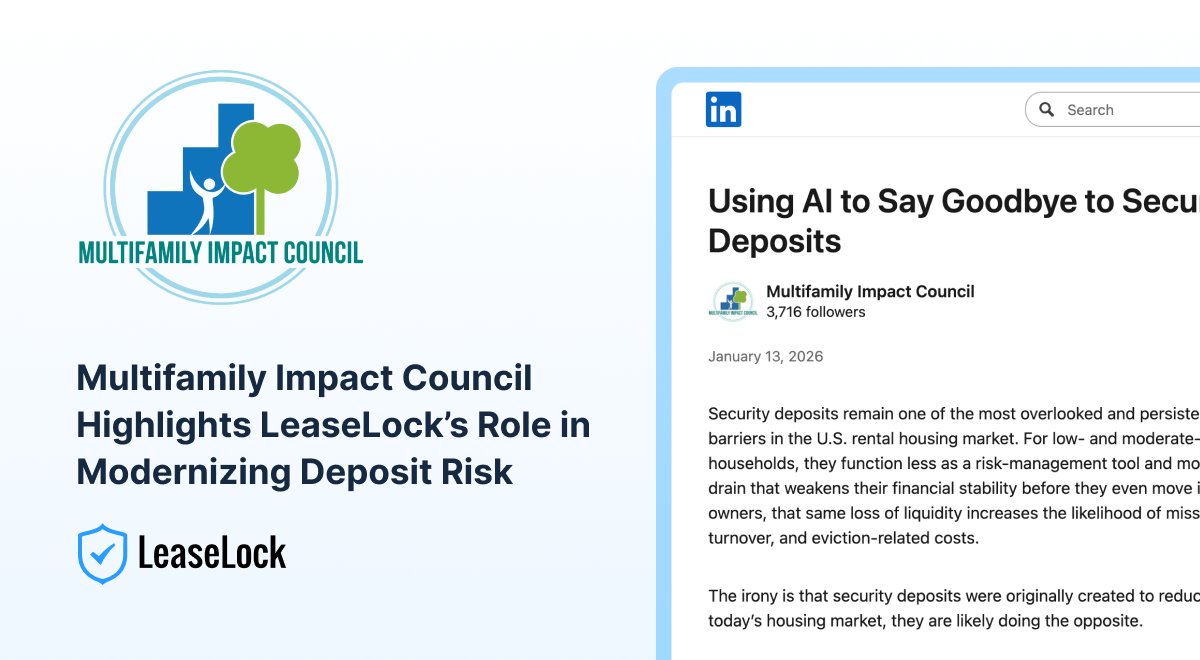
We are honored to be featured by Multifamily Impact Council in their latest edition of the Affordable Housing Handbook, Using AI to Say Goodbye to Security Deposits.
The article presents a clear conclusion. Security deposits no longer function as an effective risk management tool in today’s rental housing market. Instead, they often create financial instability for renters and introduce performance challenges for properties.
By requiring large upfront payments at move-in, security deposits reduce renter liquidity at the very moment stability matters most. For many households, this means fewer financial resources available to absorb everyday disruptions such as medical expenses, transportation issues, or temporary income changes. That reduced flexibility can quickly impact rent consistency, turnover, and operating outcomes.
The Council highlights how deposit replacement has emerged as a more modern approach. Rather than relying on immobilized renter cash, this model aligns protection to property-level performance while allowing renters to retain savings. The result is stronger household financial resilience and more consistent asset performance.
In doing so, deposit replacement bridges the gap between social impact and the bottom line. Improving renter financial stability is not separate from improving property performance. The two outcomes are directly connected.
As noted in the article, LeaseLock plays a leading role in this shift. Through technology-enabled deposit replacement, properties are able to modernize how risk is managed at move-in while improving housing accessibility for renters.
This alignment reinforces a simple principle that continues to hold true across rental housing.
Financially stable renters create financially stable assets. Impact-driven outcomes and investor returns do not have to be mutually exclusive. When renter stability improves, operating performance becomes more predictable, supporting long-term value creation across rental housing portfolios.
By replacing outdated deposit structures with solutions designed for today’s housing environment, deposit replacement supports stronger leasing outcomes, steadier operations, and more predictable performance for owners and investors.
We appreciate the Multifamily Impact Council for advancing this discussion and for highlighting how modern approaches to deposit risk can strengthen both renter stability and asset-level results.
Frequently Asked Questions:
Why are security deposits creating instability in rental housing?
Security deposits reduce renter liquidity at move in, leaving households with fewer financial resources to handle everyday disruptions. That instability can impact rent consistency and property performance.
What is deposit replacement in multifamily housing?
Deposit replacement allows properties to move away from upfront renter cash requirements while aligning protection to asset level performance rather than individual household savings.
How does deposit replacement support asset performance?
By preserving renter liquidity, deposit replacement supports steadier rent payments, lower turnover, and more predictable operating outcomes.
Why are owners and investors rethinking security deposits?
Because deposits were designed for a different era. Modern rental housing requires risk management approaches that reflect today’s renter finances and portfolio scale.
About LeaseLock
LeaseLock is the only true lease insurance provider for rental housing. Our AI powered underwriting program, LeaseLock Shield™ , predicts risk and optimizes coverage for properties and portfolios. Owners and operators gain notable profit protection while accelerating leasing, minimizing burden, and removing reputation and legal risk. With over $14 billion in leases insured, LeaseLock is reshaping the way the rental housing industry manages financial risk, while delivering significant benefits to renters. As an accredited GRESB partner, LeaseLock is dedicated to improving housing accessibility by offering renters greater financial flexibility while protecting properties against the risk
of bad debt. Learn more at www.leaselock.com.
 https://leaselock.com/wp-content/uploads/2025/08/Q2-REIT-CALL-RECAP.png
628
1200
Jonas Dominique
/wp-content/uploads/2024/04/LeaseLock-logo-black.svg
Jonas Dominique2026-03-04 13:28:442026-03-05 11:47:58Multifamily Quarterly REIT Earnings Recap – Q4 2025
https://leaselock.com/wp-content/uploads/2025/08/Q2-REIT-CALL-RECAP.png
628
1200
Jonas Dominique
/wp-content/uploads/2024/04/LeaseLock-logo-black.svg
Jonas Dominique2026-03-04 13:28:442026-03-05 11:47:58Multifamily Quarterly REIT Earnings Recap – Q4 2025 https://leaselock.com/wp-content/uploads/2026/01/Newsroom-Featured-Image-31.png
628
1200
LeaseLock Marketing
/wp-content/uploads/2024/04/LeaseLock-logo-black.svg
LeaseLock Marketing2026-01-16 10:29:262026-01-16 16:43:23Multifamily Impact Council Highlights LeaseLock’s Role in Modernizing Deposit Risk
https://leaselock.com/wp-content/uploads/2026/01/Newsroom-Featured-Image-31.png
628
1200
LeaseLock Marketing
/wp-content/uploads/2024/04/LeaseLock-logo-black.svg
LeaseLock Marketing2026-01-16 10:29:262026-01-16 16:43:23Multifamily Impact Council Highlights LeaseLock’s Role in Modernizing Deposit Risk https://leaselock.com/wp-content/uploads/2026/01/Newsroom-Featured-Image-30.png
628
1200
LeaseLock Marketing
/wp-content/uploads/2024/04/LeaseLock-logo-black.svg
LeaseLock Marketing2026-01-12 15:20:442026-01-12 15:20:48LeaseLock Chief Economist Greg Willett Featured on the Jake & Gino Podcast
https://leaselock.com/wp-content/uploads/2026/01/Newsroom-Featured-Image-30.png
628
1200
LeaseLock Marketing
/wp-content/uploads/2024/04/LeaseLock-logo-black.svg
LeaseLock Marketing2026-01-12 15:20:442026-01-12 15:20:48LeaseLock Chief Economist Greg Willett Featured on the Jake & Gino Podcast https://leaselock.com/wp-content/uploads/2025/12/Newsroom-Featured-Image-29.png
628
1200
LeaseLock Marketing
/wp-content/uploads/2024/04/LeaseLock-logo-black.svg
LeaseLock Marketing2025-12-04 10:30:102025-12-04 10:50:38Andrew Bowen Featured on the Real Estate Pros Podcast
https://leaselock.com/wp-content/uploads/2025/12/Newsroom-Featured-Image-29.png
628
1200
LeaseLock Marketing
/wp-content/uploads/2024/04/LeaseLock-logo-black.svg
LeaseLock Marketing2025-12-04 10:30:102025-12-04 10:50:38Andrew Bowen Featured on the Real Estate Pros Podcast https://leaselock.com/wp-content/uploads/2025/12/Newsroom-Featured-Image-28.png
628
1200
LeaseLock Marketing
/wp-content/uploads/2024/04/LeaseLock-logo-black.svg
LeaseLock Marketing2025-12-01 14:19:012025-12-01 14:19:02LeaseLock Chief Economist Greg Willett Featured in Bloomberg’s Coverage of Boston’s Cooling Rental Market
https://leaselock.com/wp-content/uploads/2025/12/Newsroom-Featured-Image-28.png
628
1200
LeaseLock Marketing
/wp-content/uploads/2024/04/LeaseLock-logo-black.svg
LeaseLock Marketing2025-12-01 14:19:012025-12-01 14:19:02LeaseLock Chief Economist Greg Willett Featured in Bloomberg’s Coverage of Boston’s Cooling Rental Market https://leaselock.com/wp-content/uploads/2025/11/Rethinking-Renewals-The-Smart-Strategy-for-Resident-Retention-2.png
1080
1920
LeaseLock Marketing
/wp-content/uploads/2024/04/LeaseLock-logo-black.svg
LeaseLock Marketing2025-11-24 17:34:162025-11-24 17:34:18Inside the OpTech 2025 Data Disruption Session
https://leaselock.com/wp-content/uploads/2025/11/Rethinking-Renewals-The-Smart-Strategy-for-Resident-Retention-2.png
1080
1920
LeaseLock Marketing
/wp-content/uploads/2024/04/LeaseLock-logo-black.svg
LeaseLock Marketing2025-11-24 17:34:162025-11-24 17:34:18Inside the OpTech 2025 Data Disruption Session https://leaselock.com/wp-content/uploads/2025/11/Newsroom-Featured-Image-27.png
628
1200
LeaseLock Marketing
/wp-content/uploads/2024/04/LeaseLock-logo-black.svg
LeaseLock Marketing2025-11-20 14:03:322025-11-20 14:05:55Janine Jovanovic Named Tech Vice Chair of the Real Estate Technology & Transformation Center (RETTC)
https://leaselock.com/wp-content/uploads/2025/11/Newsroom-Featured-Image-27.png
628
1200
LeaseLock Marketing
/wp-content/uploads/2024/04/LeaseLock-logo-black.svg
LeaseLock Marketing2025-11-20 14:03:322025-11-20 14:05:55Janine Jovanovic Named Tech Vice Chair of the Real Estate Technology & Transformation Center (RETTC) https://leaselock.com/wp-content/uploads/2025/10/Newsroom-Featured-Image-26.png
628
1200
LeaseLock Marketing
/wp-content/uploads/2024/04/LeaseLock-logo-black.svg
LeaseLock Marketing2025-10-21 11:32:482025-10-21 11:43:56LeaseLock CEO Janine Steiner Jovanovic Featured in Commercial Observer’s Halloween Spotlight
https://leaselock.com/wp-content/uploads/2025/10/Newsroom-Featured-Image-26.png
628
1200
LeaseLock Marketing
/wp-content/uploads/2024/04/LeaseLock-logo-black.svg
LeaseLock Marketing2025-10-21 11:32:482025-10-21 11:43:56LeaseLock CEO Janine Steiner Jovanovic Featured in Commercial Observer’s Halloween Spotlight https://leaselock.com/wp-content/uploads/2025/10/Newsroom-Featured-Image-24.png
628
1200
LeaseLock Marketing
/wp-content/uploads/2024/04/LeaseLock-logo-black.svg
LeaseLock Marketing2025-10-16 12:14:322025-10-17 13:21:50LeaseLock at OPTECH 2025: Bringing Risk Into Focus for Multifamily Operators
https://leaselock.com/wp-content/uploads/2025/10/Newsroom-Featured-Image-24.png
628
1200
LeaseLock Marketing
/wp-content/uploads/2024/04/LeaseLock-logo-black.svg
LeaseLock Marketing2025-10-16 12:14:322025-10-17 13:21:50LeaseLock at OPTECH 2025: Bringing Risk Into Focus for Multifamily Operators